Mission Illinois: Ambitions in outer space
The polymers Sottos and Chasiotis are testing on the International Space Station aren't just being studied in isolation. They have a direct connection to one of the most ambitious manufacturing projects currently headed to space.
Mission Illinois, an effort funded by the Defense Advanced Research Projects Agency (DARPA), is led by Professor Sameh Tawfick of the Department of Mechanical Science and Engineering. Researchers are set to launch a composite tube manufacturing machine to the ISS in 2026 as part of DARPA's Novel Orbital and Moon Manufacturing, Materials and Mass-Efficient Design (NOM4D) program. The goal is to manufacture carbon fiber composite structural components directly on-orbit, eliminating the need to launch fully assembled structures from Earth.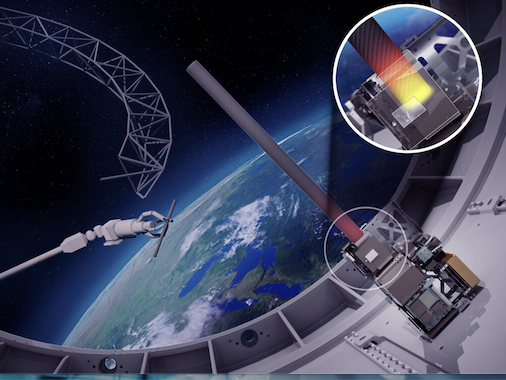
The polymer at the heart of that manufacturing process — polydicyclopentadiene, or pDCPD — serves as the matrix material in the composites Mission Illinois is designed to produce in orbit. It is the same material Sottos and Chasiotis have among their samples currently orbiting Earth.
“They are studying the effects of different additives to improve the erosion resistance of this pDCPD polymer matrix on the space station now,” said Sottos. “We hope someday the materials strategies we are developing to prevent atomic oxygen erosion will be utilized in composites manufacturing in space.”
"It would be the next generation of materials for composites manufacturing," Chasiotis said. "We'll probably incorporate some of the materials that we're placing now at the ISS for characterization and evaluation."
In March 2025, Grainger Engineering formally launched the Center for In-Space Manufacturing of Resilient Structures (SpaceMaRS), organized by Chasiotis, to bring both threads together under one roof. The center unites eight faculty members across four departments, including Sottos, with expertise spanning composites processing, hypervelocity impact mechanics, space environment simulation and new material chemistries.
"The SpaceMaRS center integrates and focuses our strong technical efforts in in-space manufacturing and structural resiliency to AO erosion and Micrometeoroids and Orbital Debris (MMOD) impact to build the future in space that many of us have imagined," Chasiotis said.
A workshop, organized by SpaceMaRS and sponsored by Illinois Grainger Engineering, will take place at the Beckman Institute for Advanced Science and Technology on May 19-20, 2026. It will bring together researchers, program managers and technology developers from academia, government labs and industry to lay out a roadmap for in-space manufacturing of resilient space structures.